Why Supply Chain Traceability Matters More Than Ever
Global trade is becoming increasingly complex. Goods may be manufactured in one country, processed or assembled in another, routed through a third country, and ultimately imported into the United States.
This complexity creates legitimate supply-chain efficiencies—but it can also create opportunities for transshipment, origin misrepresentation, and tariff evasion.
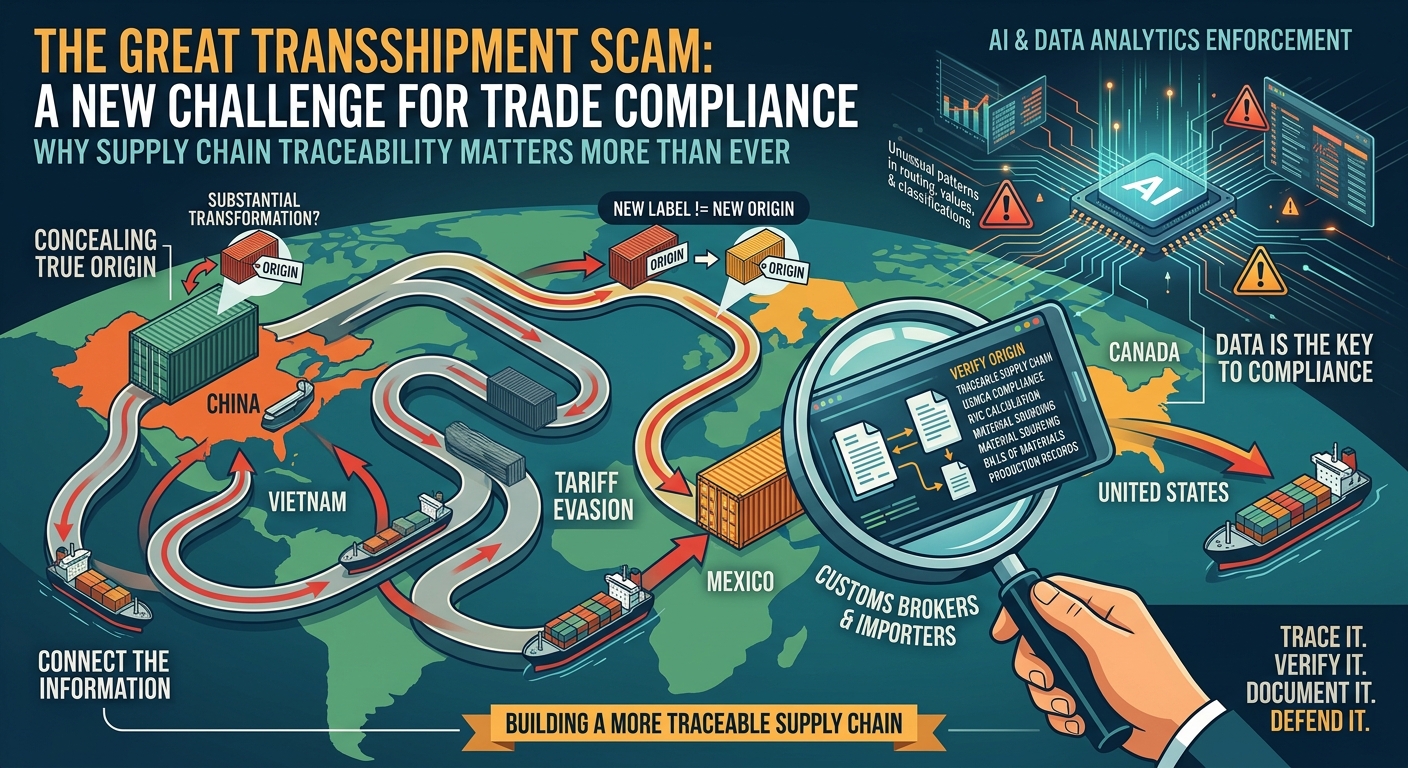
Recent U.S. government attention on transshipment has highlighted a growing concern: Chinese-origin goods may reach the U.S. through multiple countries, potentially following routes such as:
China → Other Asian Country → Mexico/Canada → United States
The critical question for importers and customs professionals is no longer simply where a product was purchased.
It is:
Where did the material actually originate, how did it move through the supply chain, and what happened to it before entering North America?
What Is Transshipment?
Transshipment generally refers to goods being shipped through one or more countries between their origin and final destination.
Transshipment itself is not necessarily illegal. Businesses routinely move goods through distribution centers, ports, free-trade zones, and manufacturing facilities in different countries.
The compliance problem arises when routing is used to conceal the true origin of goods or improperly obtain preferential tariff treatment.
For example:
China → Vietnam → Mexico → United States
If Chinese-origin components are shipped to Vietnam, undergo limited processing, and are then exported to Mexico or the United States, simply changing the shipping route does not automatically change the goods' country of origin.
The same principle applies when goods or materials move through Canada or Mexico before entering the United States.
A New Question for Importers and Customs Brokers
When reviewing a USMCA claim or a regional value content (RVC) calculation, asking:
"Where did my supplier purchase the material?"
may not provide enough information.
A stronger compliance question is:
"Can we establish where that material actually originated and document how it moved through the supply chain?"
That distinction is important.
A supplier may legitimately purchase material from a distributor in Mexico or Canada. But the distributor's location does not necessarily establish the material's country of origin.
The underlying supply chain may look very different:
Original Manufacturer → Distributor → Processor → Assembler → Exporter → Importer
Every step can potentially matter when determining origin and supporting a preferential trade claim.
Why USMCA and RVC Claims Require Careful Documentation
USMCA provides preferential tariff treatment for qualifying goods that satisfy applicable rules of origin.
For businesses relying on USMCA treatment, determining whether materials qualify can require more than reviewing a commercial invoice.
Depending on the product and applicable rule, businesses may need to evaluate factors such as:
Tariff classification
Originating and non-originating materials
Tariff shifts
Regional value content
Manufacturing operations
Supplier certifications
Bills of materials
Purchase records
Production records
Transportation documentation
This is where supply-chain traceability becomes a compliance asset.
The goal is not simply to produce paperwork after a customs inquiry.
The goal is to have documentation that tells a consistent story from source material to finished product.
A New Origin Label Does Not Automatically Mean a New Origin
One of the most important concepts in origin analysis is that routing and labeling are not necessarily the same as substantial transformation.
Consider a simplified example:
A company purchases components manufactured in China.
Those components are shipped to another country, where they undergo minor processing or are repackaged before being exported to Mexico.
The final product then enters the United States.
The fact that the product passed through several countries—or received a new commercial label—does not automatically establish a new country of origin.
The actual manufacturing process and applicable rules of origin must be examined.
This is why importers should understand what happened to the goods, not just where the goods traveled.
What Importers Should Verify
A stronger trade-compliance program should examine the supply chain behind the declaration.
1. Verify Supplier Sourcing
Understand where suppliers obtain the materials and components used in the finished product.
Questions may include:
Who manufactured the material?
Where was it manufactured?
Who supplied it?
Was it purchased through a distributor?
Does the supplier maintain supporting origin documentation?
2. Trace Declared Materials
Maintain visibility into the materials incorporated into the finished product.
A bill of materials can be particularly valuable when it connects:
Finished Product → Component → Supplier → Manufacturing Country
3. Understand the Manufacturing Process
Determine what actually happens to the goods at each stage.
Is the operation:
Simple packaging?
Sorting?
Cutting?
Assembly?
Processing?
Manufacturing?
Substantial transformation?
The answer can be critical to origin analysis.
4. Document the Origin Determination
The final conclusion should be supported by documentation rather than assumptions.
A defensible compliance file may include:
Supplier declarations
Certificates of origin
Commercial invoices
Purchase orders
Bills of materials
Manufacturing records
Production documentation
Transportation records
Customs declarations
RVC calculations
Classification analysis
AI Is Changing Trade Enforcement
There is another development that makes supply-chain transparency increasingly important:
Artificial intelligence and advanced data analytics are becoming part of the trade-enforcement environment.
Government agencies can analyze large volumes of trade data to identify unusual patterns.
Potential risk indicators may include relationships between:
Declared country of origin
Supplier and manufacturer information
Product classifications
Import values
Routing patterns
Tariff treatment
Shipment histories
Related parties
Production locations
This changes the compliance landscape.
Historically, a company might focus primarily on whether the documentation existed.
Increasingly, companies also need to consider whether the data tells a consistent story.
If customs declarations, supplier information, manufacturing records, transportation data, and tariff claims contradict one another, sophisticated analytics can potentially identify those inconsistencies.
Compliance Is Becoming a Data Problem
Trade compliance is no longer only about having a folder full of documents.
It is increasingly about connecting the information contained in those documents.
Imagine an importer claiming preferential treatment for a product manufactured in Mexico.
Its records say:
Country of origin: Mexico
But further analysis shows:
Supplier: Mexican distributor
Key components: Manufactured elsewhere
Production process: Limited processing
Transportation history: Multiple-country routing
RVC calculation: Dependent on non-originating materials
That situation deserves closer review.
The question becomes:
Can the importer demonstrate why the product qualifies under the applicable rules of origin?
If the answer is yes, the documentation becomes a powerful compliance defense.
If the answer is no, the company may face significant questions during an audit or customs review.
Building a More Traceable Supply Chain
Companies can strengthen their trade-compliance programs by treating origin information as a traceability problem.
A practical framework is:
SOURCE
Identify where materials and components originate.
TRACE
Understand how those materials move through the supply chain.
VERIFY
Validate supplier declarations and origin information.
ANALYZE
Review classification, manufacturing operations, and applicable rules of origin.
DOCUMENT
Maintain evidence supporting the final determination.
MONITOR
Continuously review changes in suppliers, sourcing countries, manufacturing locations, and trade routes.
This approach creates a much stronger compliance position than relying on a single certificate or supplier statement.
The Bottom Line
The modern supply chain can cross several borders before a product reaches its final customer.
That makes country-of-origin determination increasingly complex—and increasingly important.
For importers, manufacturers, and customs brokers, the key question should not simply be:
"Where was this product shipped from?"
It should be:
"Can we prove where it originated, what happened to it, and why our origin determination is correct?"
As customs authorities increasingly use data analytics and AI to identify unusual trade patterns, companies should expect greater scrutiny of the connections between origin, routing, suppliers, manufacturing, classification, and tariff treatment.
A new label does not automatically create a new origin.
A new route does not automatically create a new origin.
And a supplier declaration should not replace meaningful due diligence.
Trace it. Verify it. Document it. Defend it.
In the next era of global trade, supply-chain visibility is not just an operational advantage—it is a compliance strategy.