
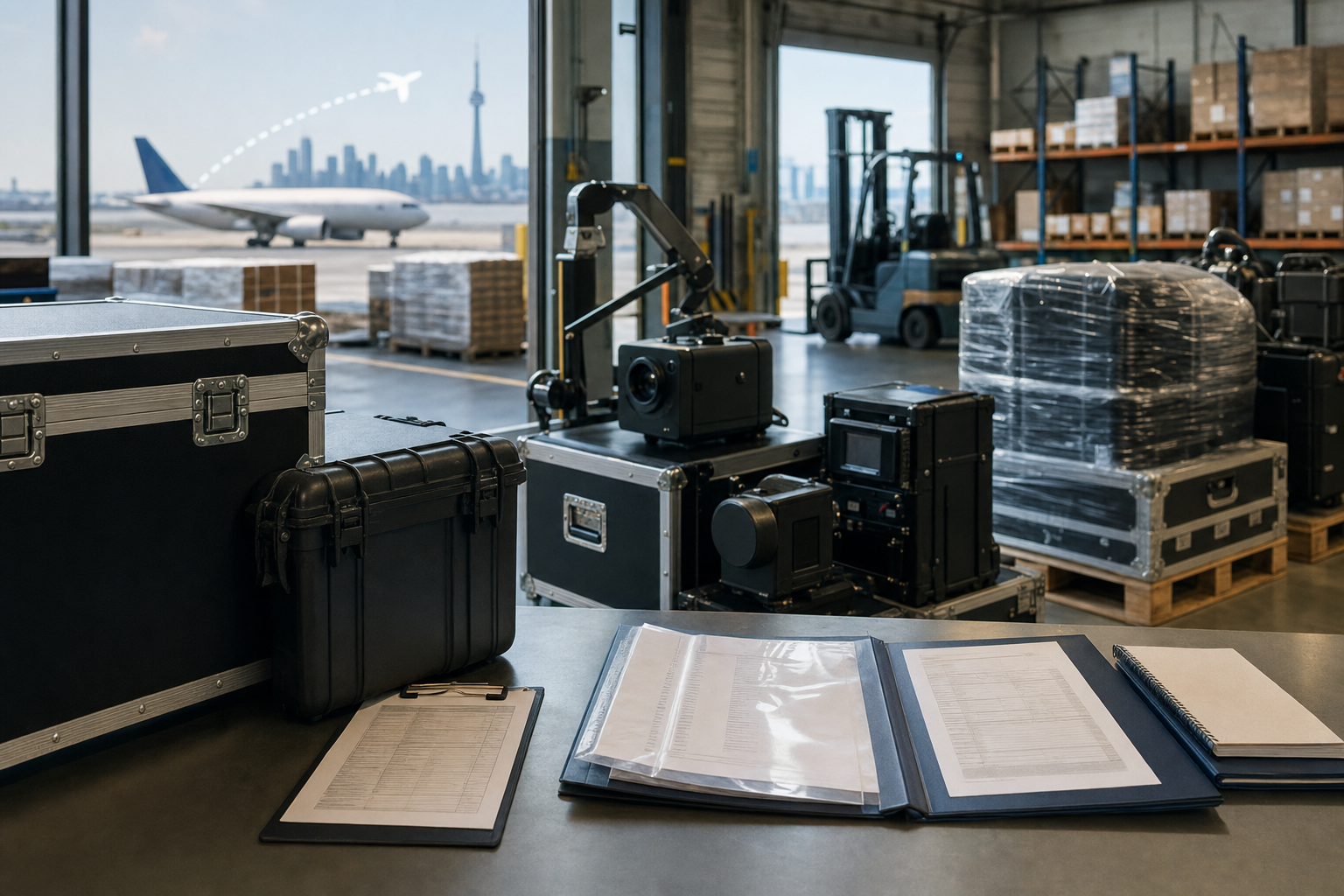
Importers bringing display equipment, commercial samples or professional gear to a Toronto-area trade show generally need to plan for two separate issues: obtaining permission for temporary entry and proving that the goods will leave Canada. An ATA Carnet can simplify both, but it is not a general exemption from Canadian import controls. The goods, their use, the paperwork and the exit process all have to match.
What an ATA Carnet does
An ATA Carnet is an international customs document used for eligible goods that move temporarily between participating countries. It serves as a customs declaration and as a financial guarantee for duties and taxes that could become payable if the goods are not re-exported under the required conditions. In Canada, the Canadian Chamber of Commerce ATA Carnet service issues or facilitates carnets for Canadian businesses and explains the application and guarantee process.
The carnet is structured around the goods, not merely the shipment. It contains a general list describing each item and customs vouchers and counterfoils for movements such as export, import, re-export and re-import. Customs authorities use those pages to record the temporary movement. The carnet holder remains responsible for presenting it and having the appropriate section completed at each border.
A carnet is commonly used for:
- Trade-show displays, demonstration units and booth equipment.
- Professional equipment used by technicians, production crews, photographers, broadcasters or engineers.
- Commercial samples that are shown or demonstrated but not sold in Canada.
- Goods moving through Canada temporarily on the way to another country, where the route and customs treatment support carnet use.
The exact eligibility depends on the goods and the intended use. A carnet does not replace a permit, licence, health approval or other authorization that may apply to controlled, regulated or restricted goods. It also does not make goods eligible simply because they are destined for an exhibition.
When a carnet is a good fit—and when it is not
Goods intended to leave Canada unchanged
The cleanest carnet scenario is equipment imported for a defined temporary purpose and then exported in substantially the same condition. A demonstration machine, camera kit, trade-show display or diagnostic device may fit that pattern when the importer retains ownership and does not sell or consume it in Canada.
Goods that will be sold, given away, consumed, installed permanently or substantially altered require a different analysis. For example, giveaway samples, promotional consumables and food served at an event do not fit the same temporary-admission logic as reusable equipment. They may need ordinary commercial entry, a specific temporary-import provision or another customs procedure.
Items that need closer review
Mixed shipments are a frequent source of errors. A single truck or air waybill may contain carnet goods, booth materials that will be discarded, merchandise intended for sale and replacement parts. Those categories should not be treated as one temporary import merely because they are travelling to the same event.
Review the following before applying:
- Whether each item will return in the same condition.
- Whether any item will be sold, transferred, consumed or left behind.
- Whether the goods require an import permit or agency approval.
- Whether the destination country accepts carnet treatment for that category of goods.
- Whether the description and serial-number information are detailed enough for customs identification.
The Canada Border Services Agency information on ATA Carnets should be read with the rules of the issuing association and the customs authority in every country on the itinerary. A carnet that works for the Canadian leg may not answer a requirement imposed by another destination.
The Canadian temporary-import sequence
1. Define the movement before preparing the document
Start with the complete itinerary: exporter, border crossings, Canadian arrival point, event dates, storage location, onward destination and planned exit. For a Toronto-area event, goods may arrive through Pearson (YYZ), move to a Mississauga staging facility or a Toronto venue, and then return through the same or another Canadian exit point. The logistics plan should allow time for customs presentation at the actual border movement rather than assuming a warehouse handoff completes the customs process.
Identify the person or company responsible for the carnet. That party should control the goods, the original document and the evidence showing where the goods are going. A freight forwarder or customs broker can coordinate the shipment, but the carnet holder and exporter remain central to the guarantee and re-export obligation.
2. Build an item-level general list
Do not describe a shipment as “trade-show equipment” and expect that label to identify every item. The general list should distinguish individual goods with practical customs identifiers such as manufacturer, model, serial number, quantity, value and a useful physical description. Photographs, packing lists and internal asset records can support the description, particularly for equipment with similar units.
Descriptions should help an officer match the physical goods to the carnet without opening an argument about identity. “Industrial camera, model and serial number” is more useful than “equipment.” For a kit, decide whether the components are listed separately or as an identifiable set, and keep the packing method consistent with the list.
3. Obtain the carnet and check it before dispatch
The issuing association normally requires an application, a general list and financial security or another guarantee arrangement. The carnet has a defined period of validity; the Canadian Chamber describes ATA Carnets as generally valid for up to one year. Check the validity, countries covered, number of planned movements and the goods list before the shipment leaves the exporter.
Before dispatch, compare:
| Check | What to confirm |
|---|---|
| Goods | Physical items, quantities, serial numbers and values match the general list. |
| Parties | The holder, representative and exporter information are consistent with the shipment documents. |
| Route | Planned entry, exit and transit countries are covered and the number of vouchers is sufficient. |
| Use | No listed item is scheduled for sale, consumption, permanent installation or unapproved alteration. |
| Validity | The document will remain valid for the planned Canadian import and re-export movements. |
4. Present the carnet at import
The carrier or representative should have the original carnet available when the goods enter Canada. Customs processing is not complete merely because the freight has arrived at Pearson or been delivered to a GTA facility. The appropriate import voucher and counterfoil need to be presented and processed according to the border procedure.
A broker can review the commercial invoice, packing list, transport document and carnet together, identify inconsistencies and coordinate with the carrier or customs office. The broker can also help determine whether a normal release entry, a temporary-import provision or another procedure is more appropriate when a carnet is unavailable or unsuitable. The broker cannot cure an inaccurate general list by changing the physical identity of the goods at the border.
5. Control the goods while they are in Canada
Keep a movement file during the event. It should connect the carnet list to the shipment, the transport records, the event or customer instruction, the storage location and any approved internal movement. This matters when equipment is unloaded in Mississauga, staged at a Brampton warehouse or delivered to a Toronto exhibition site by different vehicles.
Do not separate or substitute items casually. If equipment is damaged, repaired, replaced, sold or left in Canada, ask for a customs review before the planned export. A change that seems operationally minor can affect whether the goods still meet the conditions of temporary admission.
6. Complete re-export and obtain the exit certification
At export from Canada, the carnet and goods should be presented so customs can certify the re-export portion. The exit record is the evidence that closes the Canadian temporary movement. Keep the processed carnet, transport records, export documents and proof of delivery together until the issuing association has released or returned the guarantee according to its process.
Re-export planning should happen before the event closes. A truck leaving the venue with mixed freight, a last-minute sale to an attendee or a replacement shipment can create a mismatch between the physical goods and the carnet list. The person carrying the goods should know where and how the export presentation will occur.
Common failure modes
The carnet list is too vague
Vague descriptions create identity problems at import and export. Serial numbers may be missing, quantities may be grouped incorrectly or the listed value may not correspond to the commercial records. A broker can conduct a document-to-packing-list review before dispatch and flag items that need separate treatment.
The goods leave without customs certification
Physical departure is not the same as documented re-export. If the carrier bypasses the customs presentation, the issuing association may not receive the evidence needed to discharge the guarantee. Build the customs step into the route and instruct the carrier in writing about the original carnet and required presentation.
Temporary and permanent goods are mixed
Booth graphics, brochures, giveaway products, consumables and sale inventory often travel with reusable equipment. Separate the lists and customs treatment. A broker can help map each category to the appropriate commercial documents and identify goods that should not be included on the carnet.
The Canadian event changes the plan
Exhibitors sometimes sell a demonstration unit, leave equipment with a Canadian customer or send damaged goods for repair. Those events should be escalated before the goods move. Depending on the facts, the importer may need to account for duties and taxes, obtain a different authorization or arrange an export and replacement movement.
The itinerary includes multiple countries
Each country may have different accepted uses, customs offices and documentary expectations. Confirm the full route with the issuing association, carrier and broker. A Canadian import review cannot substitute for the export and re-import formalities required elsewhere.
What the broker should handle
A practical brokerage workflow begins before the freight is tendered. The broker can:
- Review whether the proposed goods and use appear compatible with carnet treatment.
- Compare the carnet general list with invoices, packing lists, serial-number records and transport documents.
- Identify controlled goods, mixed permanent imports and items that may need another procedure.
- Coordinate arrival instructions with the carrier and the party presenting the original carnet.
- Prepare or review the Canadian customs data required for the movement.
- Track the import and re-export evidence and investigate discrepancies before the carnet guarantee is called.
The broker should not be treated as the owner of the temporary-import obligation. The importer, carnet holder and exporter need to control the goods and make sure the intended exit takes place. Good brokerage support reduces preventable document and timing failures; it does not replace physical presentation of the goods or a valid customs record.
Pre-shipment checklist
- Separate reusable temporary goods from items for sale, consumption or permanent installation.
- Confirm the route, border points, event dates and intended Canadian exit.
- Prepare an item-level list with useful descriptions, quantities, values and serial numbers.
- Apply for the carnet through the appropriate issuing association and verify its validity and country coverage.
- Match the carnet to the invoice, packing list and transport document before loading.
- Give the carrier and customs broker clear instructions for import and re-export presentation.
- Keep the original carnet and a complete movement file under controlled custody.
- Escalate any sale, loss, damage, replacement, repair or change in route before it occurs where possible.
- Confirm that the export counterfoil or other required customs evidence has been completed before closing the file.
For a Toronto, Mississauga or Brampton trade-show movement, the main risk is usually not the temporary nature of the equipment. It is the gap between the planned itinerary and what the documents, carrier and customs records actually show. Treat the carnet as a controlled shipment record from application through re-export, and involve the broker before the freight is tendered rather than after a missing exit certification becomes a guarantee problem.