
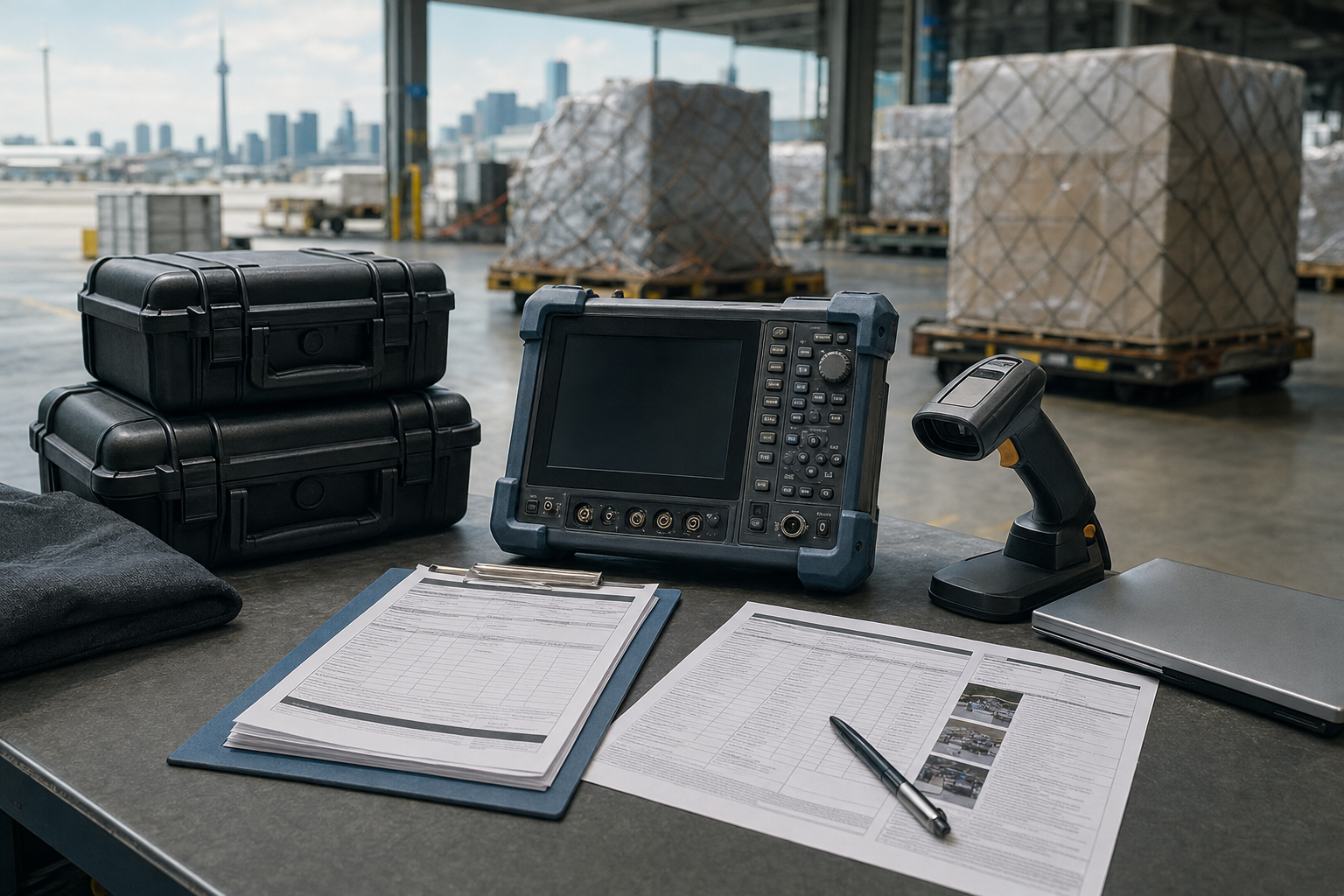
Companies bringing exhibits, demonstration units, tools or professional equipment to Canada for a limited purpose often have two separate customs questions: whether the goods qualify for temporary admission, and how to prove that they left Canada. An ATA Carnet can address both, but it is not a general import permit and it does not make every temporary shipment duty-free.
For a trade show in Toronto, equipment arriving through Pearson (YYZ), or demonstration machinery moving to a Mississauga or Brampton facility, the practical objective is to keep the shipment identifiable from the outbound packing list through Canadian presentation and re-export. A broker helps build that control process; the carnet holder remains responsible for using the document correctly.
What an ATA Carnet does
An ATA Carnet is an internationally recognized customs document and guarantee for the temporary admission of eligible commercial goods. It can replace the usual import documentation and, where the conditions are met, the payment or security arrangements associated with duties and taxes on temporary entry. The carnet is issued and guaranteed by an authorized organization in the exporting country, commonly a chamber of commerce or equivalent body.
The document contains general lists describing the goods and a set of customs vouchers and counterfoils. Customs authorities use the relevant pages when the goods leave the country of origin, enter Canada, leave Canada and return or proceed to another country. Those endorsements create the evidence that the temporary admission was properly closed.
The Canadian Border Services Agency’s guidance should be checked before shipment because eligibility depends on the purpose, condition and intended treatment of the goods. The CBSA ATA Carnet guidance and the International Chamber of Commerce ATA Carnet information describe the document’s international function.
Which goods commonly fit the carnet process
Trade-show and business goods are common candidates when they remain identifiable and are intended to leave Canada. Examples can include:
- Exhibition stands, display units, prototypes and commercial samples used for demonstration rather than sale.
- Professional cameras, testing devices, tools and other equipment brought by a business for its own work.
- Machines or instruments used for demonstration, inspection, calibration or a professional presentation.
The goods generally need to return in substantially the same condition. A serial number, asset number, model, distinctive mark, photograph or detailed description can help establish that identity. A vague description such as “equipment” is weak evidence if customs later needs to determine whether the goods that departed are the goods that entered.
Situations that need a different approach
A carnet is usually a poor fit where the goods will be sold, given away, consumed, repaired, transformed or incorporated into another product in Canada. Promotional items distributed to visitors, food and beverages used at an event, replacement parts installed into equipment, and materials used up during a demonstration require particular scrutiny. They may need ordinary import accounting, another temporary-admission procedure, or a specific permit.
A carnet also does not override Canadian controls that apply to the product. Importers who bring regulated equipment, controlled technology, radio devices, medical products, food, plants, animals or other controlled goods are generally required to address the relevant agency requirements separately. The carnet covers the customs treatment of eligible temporary goods; it is not a substitute for an import licence, safety approval or other authorization.
ATA Carnet versus another temporary-import route
The choice should be made before the goods are packed. A carnet is often useful when the shipment will cross several borders, when the same equipment will visit multiple events, or when the exporter wants one controlled document for temporary admissions. It can also reduce the need to arrange a separate financial security at each border, subject to the carnet’s terms and the customs authority’s procedures.
Other routes may be more suitable when the goods are entering for repair, testing, processing or a narrowly defined Canadian program. They may involve a Canadian customs declaration, a security or other financial arrangement, supporting documentation and a requirement to export or otherwise account for the goods by a specified deadline. Importers should not select a carnet merely because the shipment is described as “temporary.” The intended use and final disposition are decisive.
A broker can compare the stated purpose, commodity details, route and regulatory requirements before the document is issued. That review is particularly useful when a shipment contains both qualifying equipment and non-qualifying consumables. Those portions may need to travel under different customs treatments.
The workflow from planning to re-export
1. Build the goods list before the carnet is issued
Start with the commercial packing list, not the event registration. Identify each item, quantity, country of origin, serial or asset identifier, customs description and approximate value. Separate accessories, spare parts, consumables and promotional material instead of combining them under one line.
The list should be consistent with the physical shipment and the carnet application. Changes made after issuance can create avoidable problems at the border. If an item is substituted, removed or added, the issuing organization may need to amend the document before travel.
2. Confirm the Canadian purpose and route
Record the Canadian destination, event or worksite, expected arrival and planned departure. A Toronto trade show may involve an air arrival at YYZ, delivery to an exhibit contractor, movement to the venue and return to a GTA warehouse before export. Each handoff creates an opportunity for a piece of equipment to be separated from the carnet list.
Share the route with the carrier and broker, including whether the goods travel as accompanied baggage, air cargo, road freight or through a consolidator. The document must be available when customs needs to examine or endorse it. A shipment that arrives before its paperwork, or is moved to a different carrier without clear instructions, can be delayed even when the goods themselves qualify.
3. Review the completed carnet before departure
The holder should compare the final carnet against the packed goods before export. Check the holder and representative details, validity period, customs offices, general list, quantities, values and identifying marks. The broker can conduct a document review, but the exporter should confirm that the listed goods are actually being shipped.
At export from the originating country, customs normally validates the relevant export section. That first endorsement matters because the Canadian entry is part of a chain of customs records. If the export stage is missed, later authorities may question whether the carnet was properly opened.
4. Present the carnet at Canadian entry
When the goods arrive in Canada, the carrier or traveller should be instructed to present the physical carnet and goods to customs as required. For air cargo through Pearson, the delivery plan should allow time for document presentation and any examination before the freight moves to an exhibit contractor or warehouse.
The Canadian entry voucher and counterfoil need to correspond to the actual shipment. Customs may verify descriptions, quantities and identifying marks. The broker’s role can include preparing the shipment information, coordinating with the carrier, checking that the correct carnet pages are available and resolving discrepancies before the goods move onward.
5. Control the goods while they are in Canada
Keep the carnet, packing list and movement record together. A trade-show team should know which person controls the document and who is authorized to release equipment to the venue, service provider or customer. For equipment stored in a Brampton or Mississauga warehouse, the warehouse record should preserve the link between each item and its carnet line.
Do not sell, loan, dispose of or materially alter carnet goods without first obtaining advice on the customs consequences. A replacement component or damaged item can change the status of the shipment. Photographs taken at receipt and at packing for export can supplement the inventory record, although they do not replace required customs endorsements.
6. Obtain the re-export endorsement
Before the goods leave Canada, the holder should reconcile the physical shipment against the carnet list. The re-export customs office needs to endorse the relevant section. If only part of the shipment leaves, the partial export must be handled carefully so that the remaining items are not incorrectly treated as exported.
The carnet should then be presented at the next applicable customs stage in the onward country or on return to the country of origin. The issuing organization may require the completed carnet or other evidence that the temporary import was discharged. The exact process depends on the issuing country and the route.
Common failure points and the broker’s response
| Failure point | Why it creates risk | Practical control |
|---|---|---|
| Generic descriptions | Customs cannot confidently match the goods to the carnet list. | Use model, serial, material and distinguishing details; reconcile against the packing list. |
| Mixed eligible and ineligible goods | Consumables, sales stock or repair items may not qualify for the same treatment. | Split the shipment and plan the customs treatment for each category before dispatch. |
| Missing entry endorsement | The guarantee chain lacks evidence that Canada admitted the goods temporarily. | Give the carrier written presentation instructions and verify the endorsed counterfoil. |
| Unplanned sale or disposal | The goods may no longer meet the temporary-admission conditions. | Obtain customs advice before changing ownership, use or condition. |
| Missed re-export timing | The issuing organization may face a claim if discharge is not demonstrated. | Set a return milestone before the event and track the carnet to final endorsement. |
| Split return shipment | Items may be exported under different loads or carriers without a complete audit trail. | Use an item-level reconciliation and record which carnet lines leave in each shipment. |
If a carnet is lost, goods are damaged, or the shipment cannot leave as planned, the holder should contact the broker and the issuing organization promptly. Waiting until a claim is raised makes it harder to reconstruct the movement and demonstrate what happened.
What a Canadian customs broker actually manages
A broker does not issue the carnet or guarantee that the goods qualify. The broker can, however, turn the document into a controlled shipment process by:
- Reviewing the stated purpose, goods list and route for apparent eligibility issues.
- Checking consistency between the carnet, commercial documents, transport data and physical packing.
- Coordinating arrival instructions with the carrier, exhibitor, warehouse and customs representative.
- Preparing a discrepancy list when the shipment changes before arrival or re-export.
- Maintaining an entry-to-exit reconciliation and requesting evidence of the relevant endorsements.
- Escalating sales, repairs, loss, damage, regulatory controls or deadline problems before they become a customs accounting issue.
For GTA shipments, this control is especially important when freight moves quickly from YYZ to a Toronto venue, then to a Peel Region warehouse or a return consolidation point. The customs document can travel separately from the goods unless one party owns the handoff process.
A pre-departure checklist
- Confirm that the Canadian purpose is temporary and that the goods will remain identifiable.
- Separate exhibits and professional equipment from sales stock, consumables, giveaways, repair items and regulated products.
- Match every carnet line to the final packing list, quantity and identifying mark.
- Confirm the transport route, arrival office, Canadian delivery point and planned export movement.
- Give the carrier and every logistics handoff clear instructions for presenting the carnet.
- Assign one person to control the document and one record to reconcile goods at receipt and return.
- Plan for damage, substitution, partial shipment, sale or delayed departure before the event begins.
- Retain endorsed evidence from export, Canadian entry, Canadian re-export and the next relevant customs stage.
The safest carnet shipment is not simply the one that reaches Canada without duty payment. It is the one whose goods can be identified, whose movements can be reconstructed and whose re-export is evidenced. Treating the carnet as a shipment-control record, rather than just a document carried by a driver or exhibitor, prevents most avoidable failures.