
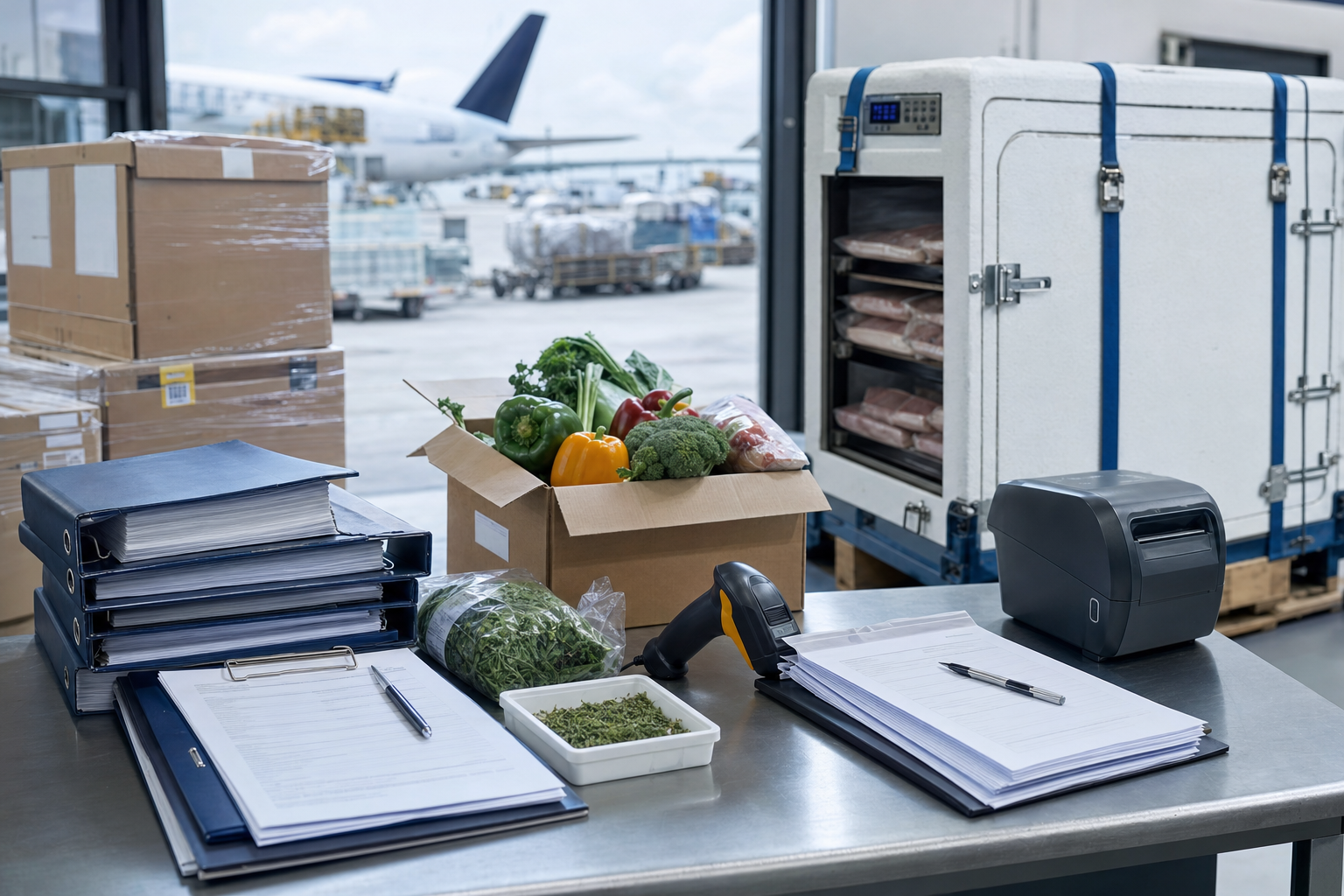
Importing food, plant or animal products into Canada involves two related decisions: whether the shipment satisfies Canadian border and customs requirements, and whether the product is admissible under the rules administered by the Canadian Food Inspection Agency (CFIA). A customs release does not, by itself, confirm that a regulated product can enter the Canadian market.
For importers moving cargo through Toronto Pearson (YYZ), a Mississauga facility, a Brampton distribution centre or another GTA point, the practical issue is coordination. The commercial invoice, tariff classification, importer details, CFIA account or licence information, permits, certificates and shipment identifiers need to describe the same transaction. A mismatch can leave freight waiting even when the customs declaration appears complete.
Two border decisions, one shipment
CBSA generally deals with the customs side of the transaction: tariff classification, origin, valuation, accounting and whether the goods may be released from customs control. CFIA requirements concern the product itself and the risks associated with food, plants, animals and related products. Depending on the commodity, another department or a provincial authority may also have a role.
These functions can be coordinated electronically, but they should not be treated as one approval. Importers who require a CFIA review generally need to provide the information and supporting documents required for that review, while also meeting the normal customs release and accounting requirements. A broker can transmit and reconcile the information, but the importer remains responsible for having the appropriate business permissions and product evidence.
The operational distinction is important:
- A shipment may be delayed while CFIA reviews a declaration, certificate, permit or product detail.
- A shipment may satisfy a CFIA requirement but still need correction of a customs value, tariff classification, origin or accounting issue.
- Goods that have been released for customs purposes may still be subject to restrictions on movement, use, sale or distribution if a separate regulatory condition has not been met.
The Automated Import Reference System (AIRS) is a key starting point for identifying CFIA requirements. AIRS results depend on details such as the commodity, origin, destination, end use, processing state and mode of transport. A broad product description is rarely enough to produce a reliable result.
Start with the product and its intended use
Before requesting a quote or booking transport, the importer should build a product profile. The profile should describe what the item is, what it contains, how it was produced or processed, where it originated, and what the importer plans to do with it in Canada.
Food products
Food importers may need to consider the Safe Food for Canadians licence, preventive controls, traceability and commodity-specific requirements. The result can differ for a raw ingredient, a processed food, a food containing animal-origin ingredients, a supplement-like product or a product intended for further processing.
The importer should verify the legal entity named on the licence, the activities covered by that licence and whether the goods being imported fall within its scope. Product descriptions should also support the applicable tariff classification and the CFIA declaration. For packaged foods, labels, ingredients, allergens, bilingual information and net quantity may become relevant to admissibility or subsequent inspection, even when the immediate customs issue is only release.
Plant and plant products
Plants, seeds, soil, wood packaging, fresh produce and other plant products can require an import permit, a phytosanitary certificate, treatment evidence or additional restrictions based on species and origin. Requirements may change according to whether the item is living, fresh, processed, dried, ornamental or intended for planting.
Importers should check the CFIA plant import guidance and the relevant AIRS result before the shipment leaves the exporting country. A certificate obtained after departure may not solve a problem if the applicable rule requires a specific document or authorization before export.
Animals and animal products
Live animals, meat, dairy, eggs, pet food, hides, semen, embryos and other animal products can trigger different requirements. The applicable rule may depend on species, disease status, processing, intended use and exporting country. Importers should consult the CFIA animal import guidance and verify whether an export-country veterinary certificate or import permit is required.
Documents should identify the product precisely. A generic description such as “animal products” may not support a decision when the requirement depends on species, tissue, processing method or end use.
The pre-shipment workflow
1. Classify and describe the goods
Start with the commercial facts rather than a preferred tariff result. Record the product name, material or ingredients, processing state, packaging, quantity, origin, manufacturer and intended use. The customs classification and the CFIA commodity description should be consistent, although they may not use identical terminology.
Where classification is uncertain, the importer should resolve the issue before shipment. A broker can review the proposed tariff item against technical documents and previous rulings, but a broker should not infer a food, plant or animal characteristic that the supplier has not documented.
2. Run the AIRS check using complete facts
Use the product profile to check AIRS. Save the result, the date of the search and the facts used to obtain it. If the result calls for a permit, certificate, licence, treatment or other condition, identify the document owner and the point in the process when it must be available.
AIRS is a reference tool, not a substitute for reading the underlying requirement. If the product is unusual, the origin is high-risk or the result is ambiguous, the importer may need confirmation from the relevant authority before shipping. A broker can flag the ambiguity and prevent a routine customs filing from being treated as evidence of product admissibility.
3. Confirm importer permissions and commercial roles
The party acting as importer should confirm that its business account, licence and registration information correspond to the legal entity on the commercial documents. Non-resident and resident importers should also ensure that the party shown as importer of record understands its responsibilities for records, declarations, duties, taxes and product compliance.
For food, the importer should review the preventive control plan guidance where applicable. This is not simply a border document exercise. The importer may need controls covering suppliers, receiving, storage, traceability, complaints, recalls and corrective action.
4. Obtain documents before loading
A useful pre-shipment file commonly includes the following, depending on the commodity:
| File element | What to check | Why it matters at release |
|---|---|---|
| Commercial invoice and packing information | Product description, seller, buyer, origin, value, quantities and package marks agree | Supports customs accounting and the regulatory declaration |
| CFIA licence or account information | Correct legal entity, activity and product scope | Allows the importer and broker to identify the responsible business |
| Permit or certificate | Correct commodity, origin, consignee, validity and shipment reference | May be an admissibility condition rather than a customs document |
| Product and label information | Ingredients, species, processing, packaging and intended use are documented | Supports AIRS analysis and inspection responses |
| Transport details | Carrier, airway bill or cargo control information and arrival point are consistent | Connects the regulatory filing to the physical shipment |
5. Submit the applicable electronic declaration
For regulated commercial imports, the broker may use the Single Window Initiative and the applicable integrated import declaration process to transmit data to participating government departments. The exact filing path depends on the commodity, importer, mode and program requirements.
The declaration should be prepared from the final documents, not from a preliminary quotation. Errors in the importer account, tariff item, country of origin, product identifier, quantity or permit information can result in a referral or a request for clarification. A release message is not a reason to discard the supporting file; the importer should retain the declaration and evidence according to its applicable recordkeeping obligations.
How the broker manages a hold or referral
When a shipment is referred, the first task is to identify which decision is pending. The issue may be a missing CFIA document, an unclear commodity description, a data mismatch, a customs accounting error or a physical inspection request. Treating every delay as a generic “customs hold” makes the response slower.
Document review
The broker compares the commercial invoice, packing list, transport document, declaration, permit and certificate. Particular attention goes to product names, quantities, country of origin, consignee, manufacturer, lot information and document validity. If the certificate describes a different product or shipment, sending it again without correction will not resolve the underlying discrepancy.
Clarification and correction
Where a supplier document is incomplete, the broker can identify the missing field and coordinate a corrected document with the importer. Where the declaration is wrong, the broker can assess whether an amendment, replacement filing or further explanation is appropriate. The broker should not alter technical product facts merely to make a filing pass a validation check.
Inspection, detention or disposition
If an authority requests an inspection, sampling, treatment, destruction, re-export or another disposition, the importer should follow the written direction and preserve the related records. The broker can coordinate the customs and transport steps, but the importer should obtain instructions from the responsible authority when the issue concerns product safety, plant health, animal health or an admissibility decision.
Common failure modes in GTA operations
- Checking AIRS after arrival. The importer discovers that a permit or certificate was required only after the shipment reaches Pearson. The practical fix is a documented pre-shipment commodity review.
- Using a supplier’s generic product name. “Food,” “seeds” or “animal parts” may conceal distinctions that change the requirement. The file should state species, ingredients, processing and intended use where relevant.
- Assuming a customs release ends the process. The cargo may move from customs control while a regulatory restriction or inspection issue remains unresolved. Release status and admissibility status should be tracked separately.
- Submitting a certificate for the wrong shipment. A certificate with a different consignee, lot, origin or quantity may not support the declaration.
- Sending regulated goods to the warehouse before the hold is understood. A Mississauga or Brampton warehouse can receive cargo physically, but receiving it does not cure an import requirement and may complicate control of the goods.
- Leaving the broker out of product changes. A new ingredient, supplier, processing method, packaging format or country of origin can change the AIRS result or customs classification.
A practical release-control checklist
Before the shipment departs, the importer and broker should be able to answer these questions:
- What exactly is the product, including ingredients, species, processing state and intended use?
- Which AIRS result applies, and has the result been saved with the facts used in the search?
- Does the importer have the applicable licence, registration or account information?
- Is a permit, phytosanitary certificate, veterinary certificate, treatment record or other document required?
- Do the certificate, invoice, packing list and transport document describe the same shipment?
- Has the customs classification, origin and value been reviewed independently of the CFIA check?
- Who will answer a CFIA or CBSA request, and where will the goods remain while the response is prepared?
- Has the final declaration been checked against the documents that will accompany the cargo?
For shipments moving through Toronto and the surrounding GTA, this checklist is especially useful when freight is scheduled for rapid transfer from YYZ to a distribution facility. It gives the broker a controlled handoff: product compliance evidence is matched to the regulatory filing, while customs evidence is matched to the release and accounting records.
Key takeaway
CFIA compliance and CBSA release should be planned as linked workstreams, not as interchangeable approvals. The importer should identify the product accurately, check AIRS before shipment, obtain the right licence and certificates, and give the broker a consistent document set. The broker’s role is to classify and transmit the customs information, connect the regulatory data to the cargo, diagnose referrals and coordinate corrections without guessing at missing product facts.
That process reduces avoidable holds, but it does not replace the importer’s responsibility to confirm that the product is admissible and that its Canadian business controls support the import.