
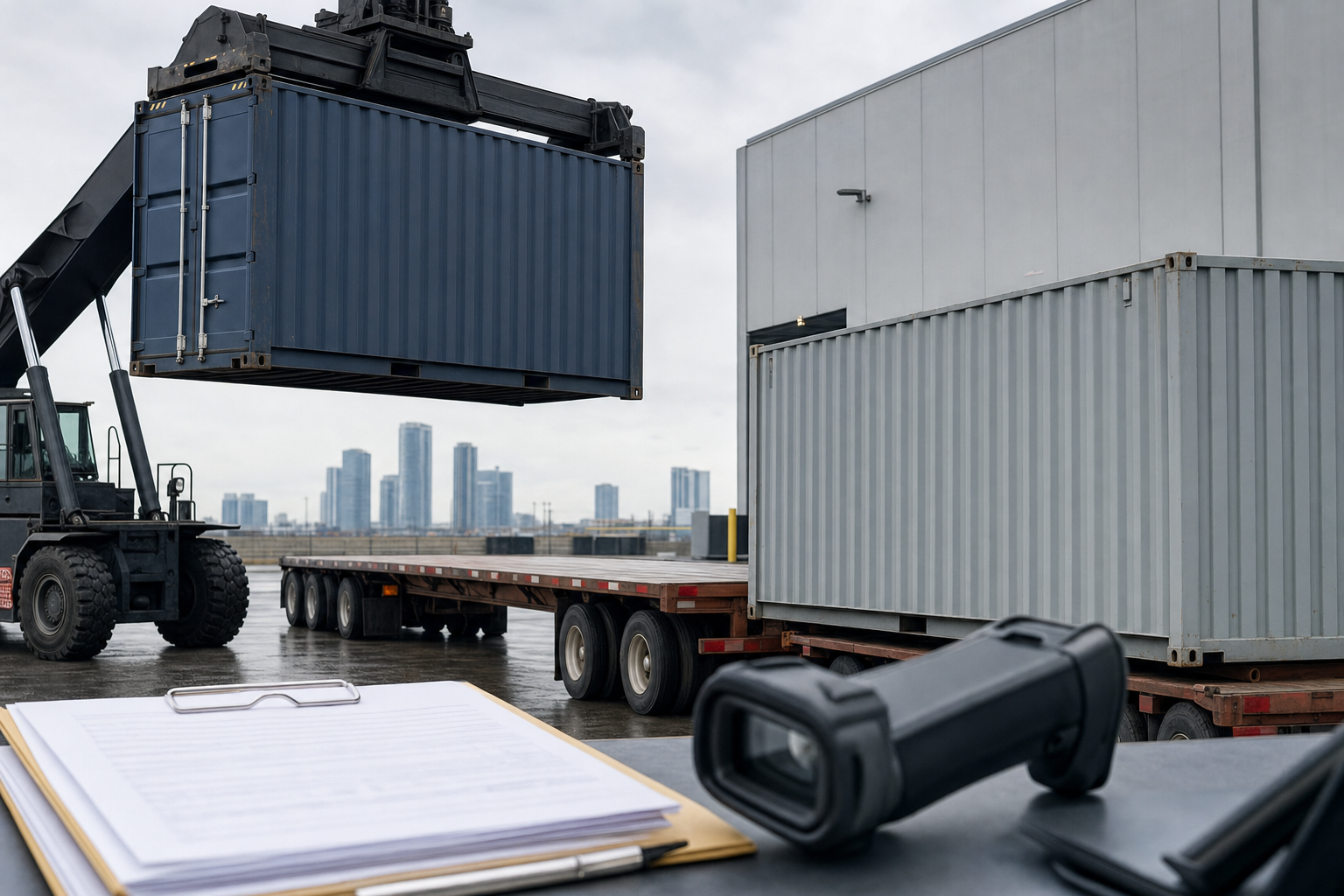
On October 30, 2026, the Canada Border Services Agency published a clarification concerning the reporting of containers used in international commercial transportation. The clarification matters most when the container itself is entering Canada as goods for sale, rather than merely carrying another shipment. Importers, carriers and freight forwarders handling marine, rail or highway movements should distinguish those two situations before transmission and accounting data are prepared.
What the October 30 notice clarifies
CBSA states that international commercial containers must be properly reported through the applicable Advance Commercial Information (ACI) or eManifest transmission. The requirement applies to full containers, empty containers and containers forming part of a consolidated shipment. The notice does not announce a separate future commencement date; it describes the reporting requirements as current requirements. CBSA Customs Notice 26-25 is the source for the clarification.
The important operational distinction is whether the container is itself being imported as a commercial good. Where a container is imported into Canada for sale, CBSA says it must be reported as an individual cargo shipment and released and accounted for with duties and taxes. Including the container number in the cargo transmission for the goods inside it is not sufficient.
The notice also states that a separate Cargo Control Document is required for each container. Penalties may apply where the reporting, release or accounting treatment is incorrect.
The classification question comes before the transmission
For an importer, the first review should be the commercial purpose and ownership treatment of the container. A unit purchased for resale is not treated the same way as equipment used to transport another imported product. Shipper-owned and importer-owned containers are specifically among the arrangements that may require closer coordination between the importer, carrier and freight forwarder.
- Container imported for sale: the container should be treated as an individual cargo shipment and accounted for with duties and taxes.
- Container carrying other goods: its reporting must still be handled through the applicable ACI/eManifest process, but the notice’s specific clarification about individual cargo accounting concerns containers imported for sale.
- Empty or consolidated container: the container is not outside the reporting requirement simply because it is empty or forms part of a consolidation.
These distinctions are particularly relevant where commercial records describe equipment, packaging and cargo inconsistently. An importer in Mississauga, Brampton or Toronto receiving container equipment for resale may need its shipment instructions and accounting workflow to identify the container as the imported good, rather than treating it only as a reference attached to the contents.
Practical controls for import files
Align the parties before cargo data is sent
Importers generally should provide the carrier or freight forwarder with clear information about whether the container is being purchased for sale, supplied as equipment or used to move other goods. The notice identifies carriers and freight forwarders as primary participants in the reporting process, but incorrect ownership or use information can create downstream delays, accounting problems or penalty exposure for importers.
A useful control is to compare the purchase order, commercial invoice, transport instructions and cargo transmission before the shipment moves. If the invoice is for container equipment, the parties should not assume that a container number appearing in another shipment record completes the reporting requirement.
Review consolidated movements separately
Consolidated freight can make it harder to determine whether the container is merely transport equipment or a product being imported. Each container should be matched to the relevant cargo-control documentation, with separate documentation maintained where the notice requires it. This is a process review, not a reason by itself to reroute freight through another gateway.
What GTA importers should do now
Importers using Peel Region warehouses or GTA distribution operations may wish to identify shipments where containers are purchased, transferred or resold in Canada. The review can be limited to the data fields and documents that establish the container’s commercial role:
- Confirm whether the container is being imported for sale or used to transport other goods.
- Confirm that the carrier or freight forwarder has the information needed for the applicable ACI/eManifest transmission.
- Check that each container has the required Cargo Control Document where applicable.
- Where the container is imported for sale, verify that it is handled as an individual cargo shipment and included in the release and accounting process with duties and taxes.
- Retain the records supporting the ownership and use classification used for the shipment.
The October 30 notice is a compliance clarification rather than a new border-access restriction. Its practical effect is to make the container’s status in the transaction more important: a container imported as merchandise should not be hidden inside the reporting for the goods it carries.